Tuggerah, NSW  ·  Community Information

Lake Road Battery Energy
Storage System (BESS)

There are changes to Australia's electricity system and as part of that, battery storage is becoming an essential part of keeping the power grid reliable. The proposed Lake Road Battery Energy Storage System (BESS) will store electricity when it is plentiful and release it when demand is highest, helping support reliable power supplies across NSW and making better use of renewable energy.

We acknowledge the Darkinjung people as the Traditional Custodians of the land on which this project is proposed, and pay our respects to Elders past and present.

About the Project

The Lake Road Battery Energy Storage System (BESS) is proposed to be a large-scale electricity storage facility at 71 - 77 Lake Road, Tuggerah.

It would support the NSW electricity infrastructure through connecting to the Transgrid high-voltage transmission network at the Tuggerah Substation adjacent to the site. The battery facility will serve to store surplus electricity from the grid when it is abundant and release it when it is needed most.

By balancing supply and demand, the project will improve grid reliability, support the integration of renewable energy, and help deliver a cleaner, more resilient electricity system for New South Wales.

The project is owned by Lake Road Battery Company, an Australian owned company that brings together the experience of Smart Commercial Solar
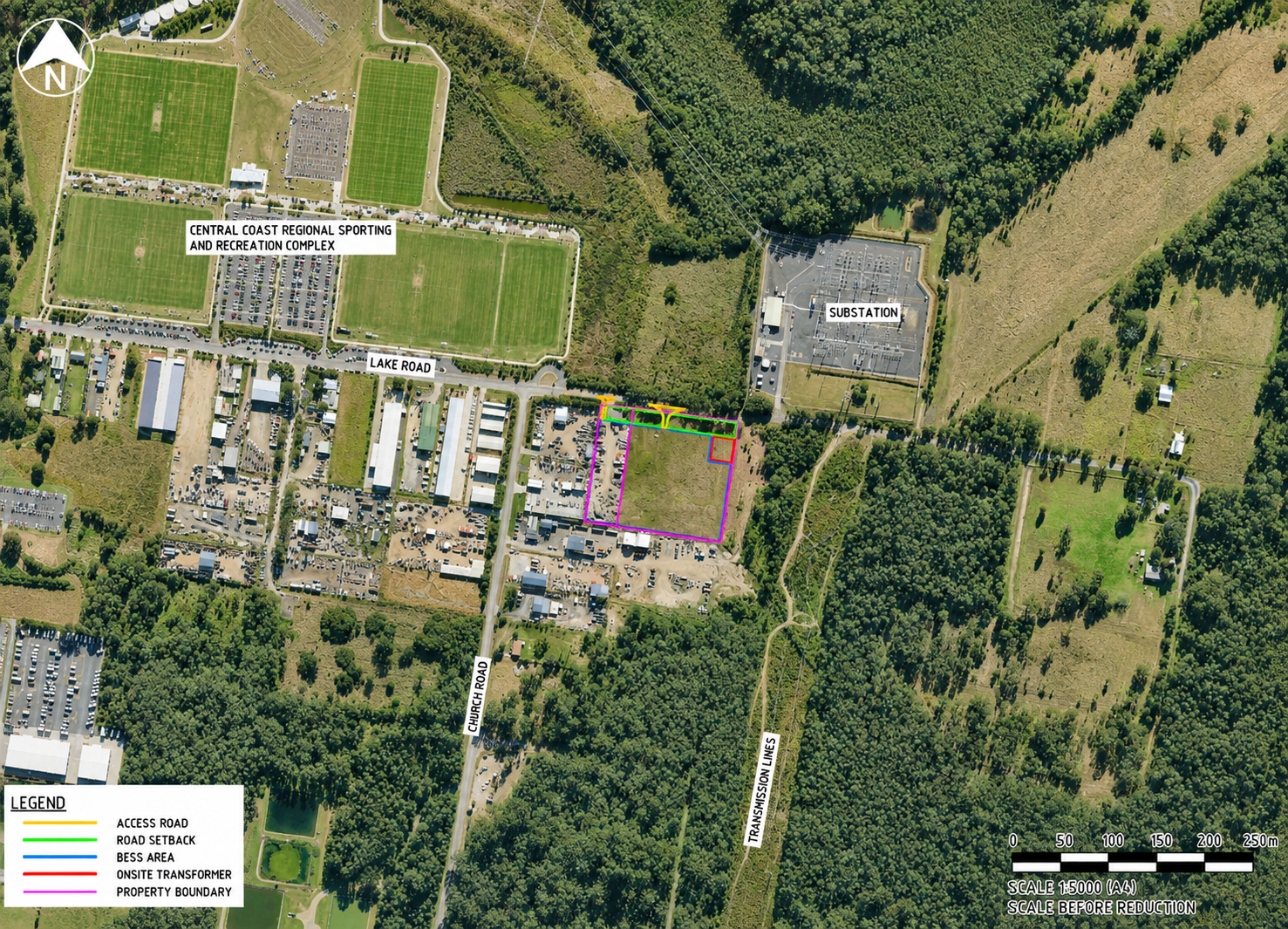
Aerial view of 71-77 Lake Road, Tuggerah NSW site location

71-77 Lake Road, Tuggerah NSW 2259

Why this site?

The Lake Road site was identified because of a combination of factors that make it well-suited to a large-scale battery energy storage facility.

Adjacent to Tuggerah Substation

The site sits directly next to the existing Transgrid substation, enabling a direct and efficient grid connection.

🏭

Existing industrial zoning

The land is already zoned for industrial use, making it an appropriate location for this type of infrastructure.

🔗

Existing transmission infrastructure

Transmission lines and substation capacity are already in place, reducing the need for new infrastructure.

🏗️

No major transmission upgrades required

The existing network can accommodate the facility's connection without significant augmentation works.

🏡

Away from residential properties

The site is located within an industrial area, separated from residential neighbourhoods.

🌿

Minimal vegetation clearing

The site requires limited clearing of native vegetation, reducing the environmental footprint of the project.

🛣️

Existing road access

Lake Road provides direct industrial-grade access to the site, suitable for construction and ongoing maintenance.

📐

Suitable topography

The site's flat terrain and dimensions are well-suited to the layout requirements of a battery storage facility.

Project Timeline and Current Status

The project will progress through the NSW State Significant Development planning process. Below is the expected sequence of steps and timing.

Mid 2026

Community & Scoping

  • Early conversations with the community and stakeholders about the project
  • Scoping Report prepared and submitted to NSW Department of Planning, Housing and Infrastructure (DPHI)
  • Secretary's Environmental Assessment Requirements (SEARs) received from the NSW Government. This is the document will guide preparation of the Environmental Impact Statement (EIS).
Completed

Environmental Impact Statement (EIS)

  • EIS completed and submitted to DPHI
  • Community consultation undertaken
  • Traffic management study complete
  • Noise and vibration studies complete
  • Flood, fire, environment and heritage assessments complete
Now
September 2026

Transgrid Application

  • Preliminary approval for 400 MW connection received
  • Final Grid Performance Studies being completed and submitted in September 2026
Early 2027

Approval to Commence Construction

  • Public exhibition of the EIS
  • Submissions from the public invited
  • Review of submissions
  • Assessment by DPHI
  • Decision on application and conditions of approval
End of 2027

Construction

  • Construction begins, subject to planning approval

Benefits of the Lake Road BESS

The Lake Road BESS will deliver a range of benefits to the electricity system and to the broader community.

🌱

Support and enable renewable energy

Stores surplus renewable electricity that would otherwise be wasted, enabling more solar and wind energy to be used effectively.

🔌

Minimise new transmission lines

By connecting to existing infrastructure at Tuggerah Substation, the project reduces the need for new transmission infrastructure.

👷

Local construction jobs

The project will create local employment opportunities during the construction phase.

Improve grid stability and reliability

Helps balance supply and demand on the network, reducing the risk of blackouts and voltage fluctuations.

💡

Enable more affordable electricity

Reduces reliance on expensive gas peaking plants during high-demand periods, helping to moderate wholesale electricity costs.

How the Lake Road BESS works

Battery storage is critical infrastructure for a modern electricity grid. Here is how this facility fits into the system.

1
Charging

Renewable energy enters the grid

Solar farms and wind turbines across NSW generate electricity and often produce more than is needed in real time. This surplus pushes prices down on the wholesale electricity market, and without storage, much of it is wasted.

2
Storage

Energy is stored at Lake Road

The 1,600 MWh of battery capacity charges from the grid when electricity is cheap and abundant, absorbing renewable energy that would otherwise be lost. The facility is planned to be connected directly to the Transgrid high-voltage transmission network.

3
Dispatch

Energy released when the grid needs it

During peak demand, typically early evenings or during extreme weather events — the battery discharges into the Transgrid network, stabilising frequency, supporting voltage, and reducing the risk of widespread outages.

4
Benefit

Homes and businesses benefit

More grid stability means lower wholesale price spikes during peak periods, less reliance on expensive gas peaking plants, and a more reliable electricity supply for homes and businesses across the Central Coast and beyond.

How energy flows through the system

☀️🌬️
Renewables
Solar & wind
Transmission Grid
Transgrid 132kV
🔋
Lake Road BESS
1,600 MWh
🏠🏭
Consumers
Homes & businesses

About the Technology

The facility will use Sungrow's Power Titan 3.0 battery system, a proven utility-scale technology that is operating in battery energy storage projects around the world.

Each battery unit is a fully integrated cabinet that houses the battery cells, power conversion equipment, cooling system and built-in fire protection. Every unit is factory assembled, tested and certified before being delivered to site, ensuring consistent quality, reliability and safety.

Lithium iron phosphate (LFP) battery chemistry has been chosen because it is one of the safest lithium battery technologies available. Unlike other chemistries commonly used in consumer electronics and some electric vehicles, LFP batteries are less likely to overheat. LFP is widely used in large-scale energy storage systems where safety, reliability, and long service life are important.

Project Technical Summary

Total storage capacity1,600 MWh
Maximum export power400 MW
Grid connection voltage132 kV
Network operatorTransgrid
Battery chemistryLFP (lithium iron phosphate)
Inverter technologySungrow Power Titan 3.0
Site areaTo be confirmed
Design operational life25 years

Frequently Asked Questions

If your question isn't here, please contact us and we will respond.

A Battery Energy Storage System (BESS) is a large-scale energy storage facility that stores energy for use at a later time. When there is more electricity being produced than needed, for example, on a sunny or windy day. The battery stores that extra power. Later, when electricity demand is higher, the battery releases the stored energy back into the grid.
Renewable energy is by far the cheapest available source of new electricity generation. As coal power stations close, this capacity needs to be replaced. Batteries help improve grid stability and reliability, help balance supply and demand on the grid, and help avoid blackouts by quickly responding to sudden drops in supply.
Battery storage supports and enables renewable energy, reduces the need for new transmission lines, provides local employment during construction, improves grid stability and reliability, and can help deliver more affordable electricity by reducing reliance on expensive gas peaking plants.
Construction traffic to the site at 71 - 77 Lake Road will use the Lake Road access route. All construction hours will comply with standard NSW EPA noise and hours guidelines. Once the facility is operational, it requires only occasional maintenance visits, typically a small number of vehicles per month during normal business hours.
The design of battery cells, charging management, fire suppression systems and temperature monitoring significantly improve safety and reduce risk. The layout of the plant, spacing between components and Asset Protection Zones further minimise potential fire risk. Consideration of fire risk is a key design component for ensuring the safety of surrounding communities.
The project is designed with a 25-year operational life. After that period, it is envisaged that the batteries will be decommissioned and recycled in accordance with applicable NSW regulations and NSW Government environmental management obligations. The site would then be remediated as required by the NSW Government planning approval conditions.
The project is subject to approval by the NSW Department of Planning, Housing and Infrastructure as a State Significant Development. Public consultation is required and we will notify neighbours, Aboriginal groups, users of the Central Coast Regional Sporting and Recreation Complex and other interested stakeholders. Following the release of the Environmental Impact Statement there will be a formal public exhibition and an opportunity for the community to make submissions.
The battery connects to the high-voltage Transgrid transmission network, not to the local distribution network that services homes and businesses in Tuggerah. Its operation will not affect your household electricity supply or cause localised outages. The facility's role in the electricity market is to improve overall grid stability and reduce the likelihood of system-wide stress events. It is part of the solution to blackout risk.
Submissions can be made directly to the NSW Department of Planning, Housing and Infrastructure when the proposal is formally exhibited. Information about this will be posted on this page and on the Department's website. At this time you can contact us at community@lakeroad.com.au or 1800 943 713 at any time.

Project Documents

Key project documents will be made available here as they are completed and approved for public release.

We want to hear from you.

Feedback we get from early consultation will help shape the project. If you have a questions not covered here, please get in touch. Our team will answer your questions.

Contact the project team

community@lakeroad.com.au
Lake Road Battery Company
71-77 Lake Road,
Tuggerah NSW 2259

Stay informed

Updates and links to information will be provided on this page.

Community information sessions will be held when the scoping report is available. Details will be posted on this page.

If you would like us to let you know when this information session is held please give us your details by completing the form.

Send us a message

Fill in the form below and we will get back to you promptly.